
Overview
Kinetix servo drives offer advanced adaptive tuning features designed to improve motion performance while reducing the need for manual tuning adjustments. Two of these features are Load Observer and Tracking Notch Filters.
Both features operate in real time while the machine is running. Load Observer estimates and compensates for changing mechanical loads, while Tracking Notch Filters identify and mitigate mechanical resonances by dynamically adjusting filter frequencies.
Together, these features can help maintain motion performance as machine conditions change, reducing the need for repeated manual tuning. With these features enabled 95% of applications can now be handled with out of the box tuning parameters!
Default-enabled Load Observer
With Logix Designer version 33.00 and later, Load Observer is enabled by default on the following drives, so the additional configuration steps for Load Observer are not required for tuningless operation:
- Kinetix 5300 drives
- Kinetix 5700 ERS3 Series B drives with firmware revision 13 or later
- Kinetix 5700 ERS4 drives with firmware revision 13 or later
Verify the actual drive and firmware configuration before commissioning.
1. Load Observer
How it works
Load Observer operates continuously while the machine is running. It estimates the mechanical load inertia acting on the motor and compensates for the effects of that load on the motion system.
By compensating for the estimated load, the drive can control the motor with a response closer to that of an unloaded system. This can improve motion performance without requiring the user to manually retune the drive every time the mechanical load changes.
Load Observer can also help compensate for variations in the mechanical system, including:
- Changing loads during machine operation
- Mechanical compliance
- Changes in system dynamics as the machine wears over time
Benefits
Load Observer is particularly useful for applications where the mechanical load is not constant.
For example, a machine may handle different product weights, experience changing process forces, or have mechanical characteristics that vary throughout its operating cycle.
Without adaptive compensation, these changes can affect the response of the servo system and may require tuning adjustments to maintain performance.
Load Observer estimates and compensates for the changing load in real time, helping the drive maintain consistent control performance.
2. Tracking Notch Filters
How they work
Tracking Notch Filters operate in real time while the machine is running. The drive monitors the mechanical system for resonant frequencies and dynamically adjusts notch-filter frequencies to mitigate the effects of those resonances.
Mechanical resonances can occur when components such as belts, couplings, gearboxes, and machine structures flex or vibrate. These resonances can limit the achievable servo bandwidth and contribute to unwanted vibration or reduced motion performance.
Traditional notch filters are typically configured around known resonant frequencies. However, those frequencies can shift as operating conditions change.
Tracking Notch Filters address this by adapting the filter frequencies during operation rather than relying entirely on fixed settings.
Benefits
Tracking Notch Filters can be useful in machines where resonant frequencies vary with operating conditions or mechanical loading.
Potential benefits include:
- Reducing the effects of mechanical resonance
- Helping maintain motion performance as operating conditions change
- Reducing the need to manually identify and configure changing resonant frequencies
- Supporting smoother motion in systems with variable mechanical characteristics
3. Using Load Observer and Tracking Notch Together
Load Observer and Tracking Notch Filters address two different challenges in servo tuning.
|
Feature |
Load Observer |
Tracking Notch Filters |
|---|---|---|
|
Primary purpose |
Compensate for changing load inertia |
Mitigate mechanical resonances |
|
Operation |
Real time |
Real time |
|
Main technique |
Estimates load and compensates for its effects |
Dynamically adjusts notch-filter frequencies |
|
Helps address |
Changing loads and mechanical variations |
Changing resonant frequencies |
|
Main benefit |
More consistent motor response |
Reduced effects of vibration and resonance |
When used together, these features can help the servo drive adapt to changing mechanical conditions while maintaining motion performance.
For example, a machine that handles products of different weights may experience changing inertia as well as changes in mechanical resonance. Load Observer compensates for the changing load, while Tracking Notch Filters adapt to resonances that may affect the motion system.
4. Tuningless Operation and Autotuning Considerations
Tuningless operation uses adaptive features to reduce the amount of manual tuning required to achieve acceptable motion performance.
On the supported drive and firmware combinations listed above, Load Observer is enabled by default when using Logix Designer version 33.00 or later. This means the user does not need to perform the additional Load Observer configuration steps to obtain tuningless operation.
Important
If Load Observer and Tracking Notch Filters are enabled and configured for adaptive operation, do not automatically assume that another autotune is necessary.
These features are designed to adapt to changing conditions while the machine is running. Running an autotune can change the tuning configuration and may interfere with the intended adaptive setup.
Before commissioning:
- Verify the drive model, series, firmware revision, and Logix Designer version.
- Confirm that Load Observer is enabled where supported.
- Verify the Tracking Notch configuration and its availability for the selected drive.
- Test the motion system under representative operating conditions.
- If performance issues occur, investigate the motion response, load characteristics, and filter behavior before changing tuning parameters.
Default-enabled Load Observer does not mean every machine is automatically optimized or that no commissioning is needed. Mechanical limitations, feedback configuration, motion profiles, and application requirements still matter.
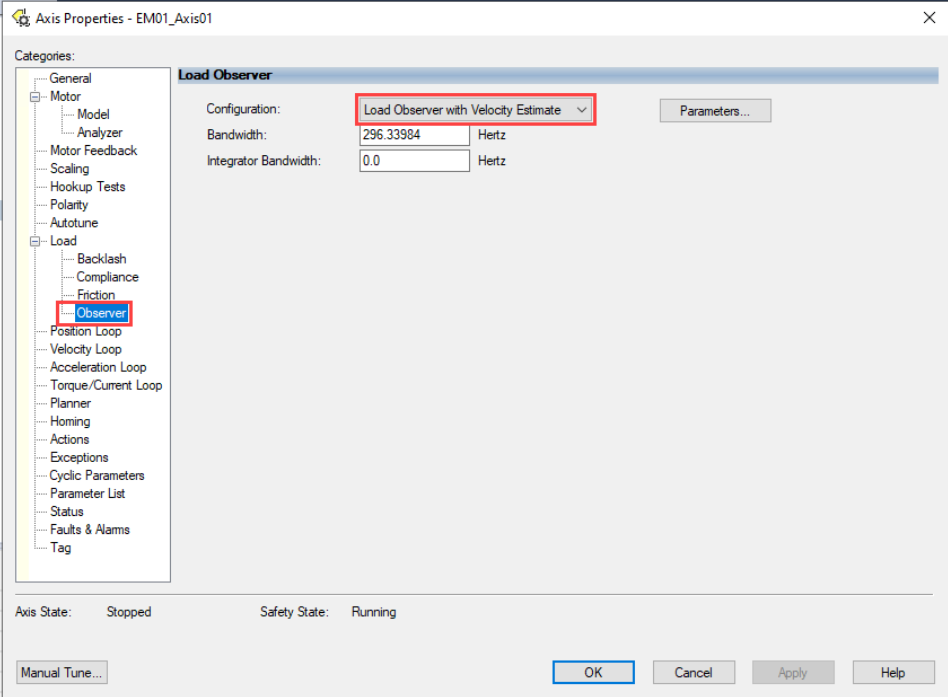
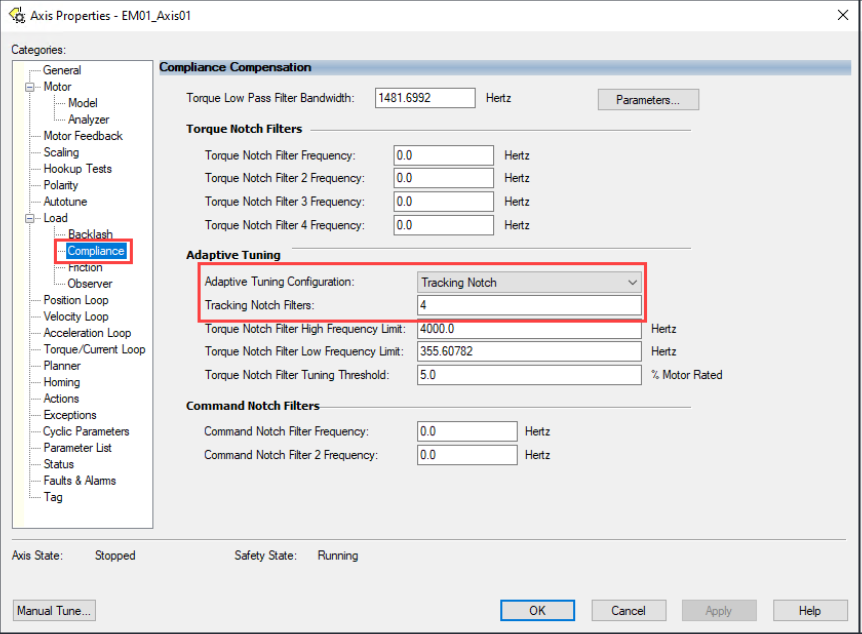
5. How to enable/disable
Load Observer and Tracking Notch are found in axis properties:
5. Summary
Load Observer and Tracking Notch Filters provide adaptive tuning capabilities that help Kinetix servo drives respond to changing machine conditions.
- Load Observer estimates mechanical load inertia and compensates for its effects in real time, helping the drive maintain a consistent response as loads and mechanical characteristics change.
- Tracking Notch Filters monitor for mechanical resonances and dynamically adjust notch frequencies to mitigate their effects during operation.
- Tuningless operation can reduce the need for manual tuning, and Load Observer is enabled by default on specified Kinetix platforms when used with Logix Designer version 33.00 and later.
Together, these features can reduce repeated manual tuning adjustments and help maintain motion performance as the machine operates under varying conditions.
The key advantage is adaptive performance: rather than relying exclusively on tuning performed under one set of machine conditions, the drive can compensate for changing loads and resonances while the machine is running.