
What is Virtual Torque Sensor?
The Virtual Torque Sensor uses information available within the servo drive to calculate the real-time air-gap torque at the motor shaft.
This allows users to monitor motor torque without installing an additional physical torque sensor in the mechanical system. Huge cost and complexity savings!
VTS provides:
- Greater than 95% accuracy of motor rated torque when operating above 20% of motor rated speed
- 100 Hz bandwidth
- Real-time motor air-gap torque information
- No additional torque-sensing hardware
- A built-in solution that is available at no additional cost
Key Specifications:
| Feature | Specification |
|---|---|
| Introduced | Studio 5000 Logix Designer® version 33.00 |
| Supported platforms | Kinetix 5700, Kinetix 5300, ArmorKinetix® |
| Measurement | Motor air-gap torque |
| Accuracy | >95% of motor rated torque |
| Accuracy operating range | Above 20% of motor rated speed |
| Bandwidth | 100 Hz |
| Additional hardware | Not required |
| Cost | Free / included feature |
Traditional torque measurement typically requires a physical torque sensor to be installed between the motor and the mechanical load. This can add hardware, wiring, installation time, and cost to a machine.
VTS eliminates the need for an external torque sensor by using information available from the Kinetix drive to estimate the motor's air-gap torque.
The resulting torque signal can be monitored in the control system and used as an additional source of machine information.
This provides engineers and machine builders with greater visibility into the mechanical load without requiring modifications to the machine's mechanical design.
Applications
VTS can be used to monitor the torque profile of a machine during normal operation.
By establishing what the normal torque profile looks like, users can identify changes in the mechanical load over time.
An increase or change in the expected torque profile may indicate a change in machine conditions such as:
- Increased mechanical friction
- Mechanical obstruction
- Changes in machine loading
- Bearing or gearbox issues
- Belt or chain tension changes
- Mechanical wear
By using the normal torque profile VTS can provide additional information when troubleshooting mechanical problems.
For example, if an axis normally requires a consistent amount of torque during a particular portion of its motion but begins requiring significantly more torque, the torque profile can help identify where additional mechanical investigation may be necessary.
This gives engineers another diagnostic signal in addition to traditional motion parameters such as position error, velocity error, and motor current.
Changes in the torque required to perform the same machine operation can be useful for identifying developing mechanical issues before they cascade into a larger machine problem.
Machine Commissioning
VTS can also be used during machine commissioning to better understand the relationship between the motor and mechanical load.
Monitoring the torque produced during different portions of the machine cycle can help identify unexpected loading conditions and verify that the mechanical system is operating as expected.
Benefits of VTSThe Virtual Torque Sensor provides several benefits compared with installing a physical torque sensor:
- No additional hardware required
- No additional torque sensor wiring
- No mechanical modification required to install a torque transducer
- Real-time torque information
- >95% accuracy of motor rated torque above 20% motor rated speed
- 100 Hz bandwidth
- Can be used for machine monitoring and diagnostics
- Available as a free feature on supported Kinetix platforms
How to Enable in Studio 5000
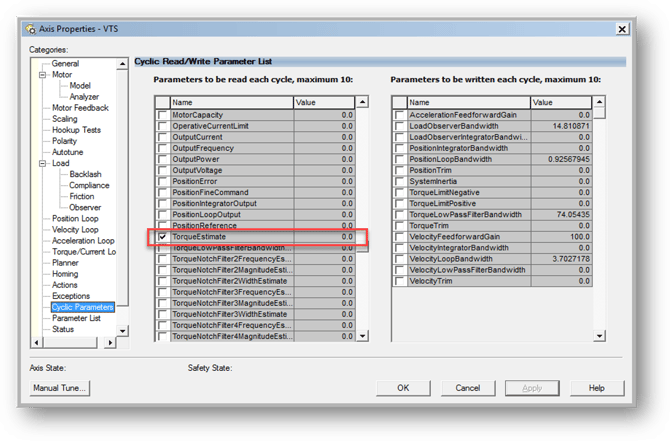
All VTS features are found in the axis properties, to enable it in Supported drive platforms find "TorqueEstimate" in the Cyclic Parameters section and enable it.
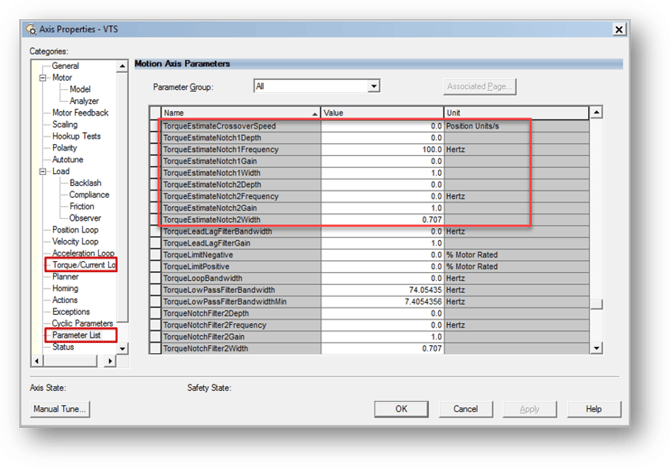
To see the more specifics of the filter please look into the Parameter List
The Virtual Torque Sensor (VTS) provides Kinetix users with a real-time estimate of motor air-gap torque without requiring a physical torque sensor.
With greater than 95% accuracy of motor rated torque above 20% motor rated speed and a 100 Hz bandwidth, VTS can provide valuable information for monitoring machine operation, diagnosing mechanical issues, commissioning equipment, and supporting maintenance activities.
Because VTS is implemented within supported Kinetix servo systems, users can gain torque-monitoring capabilities without adding a physical torque sensor or additional machine hardware.
VTS gives machine builders and engineers another way to turn the servo drive into a source of actionable machine information.