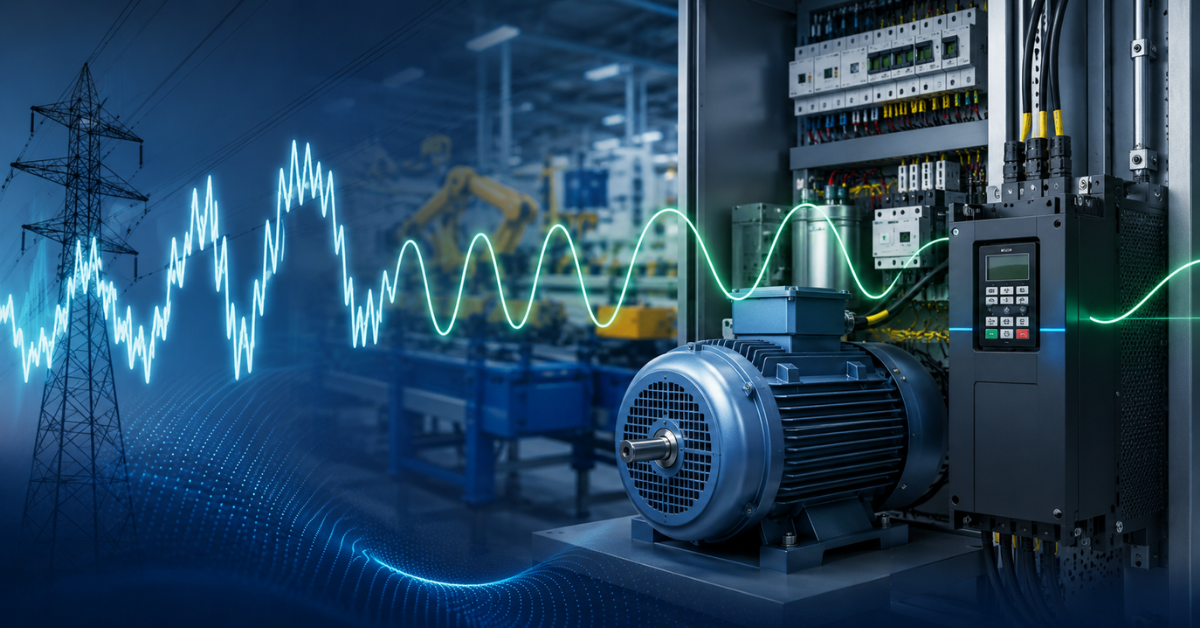


Variable frequency drives (VFDs) have become essential in modern manufacturing, offering greater motor control and significant energy-saving opportunities. But they can also introduce an often-overlooked challenge into your electrical system: harmonic distortion.
Excessive harmonics can contribute to nuisance breaker trips, transformer overheating, control system disturbances, flickering lights, and premature wear on electrical components.
So, how do you know when harmonics are becoming a problem—and what can you do about them?
In this ES&E video, Mark Garner with Electric Supply & Equipment and Patrick Donohue with Hammond Power Solutions (HPS) break down IEEE 519 and the solutions available to help manufacturers improve power quality and protect their electrical systems.
What Is IEEE 519?
IEEE 519 establishes recommended limits for harmonic distortion within an electrical system.
One important concept discussed in the video is the Point of Common Coupling (PCC). This is generally the point where utility power enters a facility and where the customer's electrical system connects with the utility.
Managing harmonic distortion at this point helps prevent a facility's nonlinear loads from negatively affecting the electrical system.
Why Should Manufacturers Care About Harmonics?
Harmonic distortion isn't simply a power-quality number on a report. Excessive distortion can create real operational problems throughout a facility.
Potential effects discussed in the video include:
- Intermittent or nuisance breaker trips
- Increased transformer heating
- Erratic control system signals
- Flickering lights
- Premature wear on electrical components
- Reduced overall electrical system reliability
One of the major contributors to harmonics in industrial facilities is the widespread use of six-pulse VFDs.
A VFD converts incoming AC power to DC as part of its operation. This makes the VFD a nonlinear load, which creates harmonic distortion. Other AC-to-DC power supplies can also generate harmonics, although the appropriate mitigation strategy may vary depending on the load type.
Choosing the Right Harmonic Mitigation Solution
Fortunately, there are several ways to address harmonics depending on your application.
Passive Harmonic Filters
For an individual VFD application, a passive harmonic filter can provide a straightforward approach to harmonic mitigation.
When properly sized for the voltage and horsepower of the VFD-motor combination, passive filters are designed to target the harmonics commonly associated with six-pulse drives.
They also have no moving parts and require minimal maintenance.
Active Harmonic Filters
Facilities with multiple drives or plans for future expansion may benefit from an active harmonic filter.
Rather than installing a separate filter for each drive, a single active harmonic filter can compensate for multiple VFDs. The system can also be scaled as additional nonlinear loads are added.
HPS active harmonic filters can provide valuable electrical information, including:
- Harmonic distortion across all three phases
- Phase balance
- Phase loss
- Historical data logging
- Ethernet-based communications
For Rockwell Automation users, the solution also includes an Add-On Profile that allows the active harmonic filter to integrate into a Rockwell PLC system.
Because the filter is connected in parallel, maintenance or repair of the filter does not necessarily require the process itself to stop running.
What About Line Reactors?
Line reactors can provide valuable protection for VFD applications, including protection against surges and additional inductance.
However, as discussed in the video, a line reactor alone should not be considered an IEEE 519 harmonic mitigation solution.
Its effect on harmonic distortion also depends on the drive. For example, adding a reactor to a drive that already contains a DC choke may produce relatively little additional harmonic reduction, while smaller drives may see a more substantial improvement.
Protecting the Motor Side of the VFD
Power quality considerations don't end at the VFD input.
The distance between a VFD and a motor can create additional challenges, including reflected-wave voltage.
As cable length increases, impedance differences between the cable and the motor can cause reflected voltage waves to travel back toward the drive. These waves can create damaging voltage spikes.
HPS offers several solutions for addressing these output-side challenges.
dV/dt Filters
For longer distances between the drive and motor, a dV/dt filter can help absorb reflected wave energy.
Unlike a standard load reactor, a dV/dt filter incorporates a resistor bank designed to absorb the energy created by reflected waves.
Sine Wave Filters
For applications with extremely long distances between the VFD and the motor, HPS also offers sine-wave filters.
A sine wave filter takes the PWM output from the VFD and produces a nearly sinusoidal waveform for the motor.
Potential benefits include:
- Support for very long motor lead lengths
- Reduced stress on motor insulation
- Reduced audible motor noise
- Cleaner power is delivered to the motor
The video discusses HPS sine-wave filter applications for motor distances up to 15,000 feet.
Cleaner Power. Better Reliability. Longer Equipment Life.
VFDs aren't going anywhere—and neither are the power-quality challenges that can accompany nonlinear loads.
Understanding IEEE 519 and selecting appropriate harmonic mitigation and VFD protection products can help facilities reduce electrical problems and improve the reliability of critical equipment.
Whether your application requires a passive harmonic filter, an active harmonic filter, a line reactor, a dV/dt filter, a sine wave filter, or another VFD solution, ES&E and Hammond Power Solutions can help you determine the right approach.
Have questions about harmonics or IEEE 519?